
Is Nothing Sacred?
The White House, the Met Police and the UK Home Office: the memeification of serious matters
2026 started with a bang. Following the astonishing capture of Nicolas Maduro, then-President of Venezuela, on 3 January – the US White House managed to frame and communicate their message in 17 seconds with a video on their social media.
The video is made for virality: it’s funny, catchy and undeniably effective – but should we really be laughing?
In just 17 seconds, a brazen violation of international law was reduced to a funny meme by one of the most powerful institutions in the world. Released the day of the kidnapping, the video achieved 75M views on TikTok as of 13 Jan. The same video was released on Instagram, and this comment on the White House’s Instagram page summarises it well:
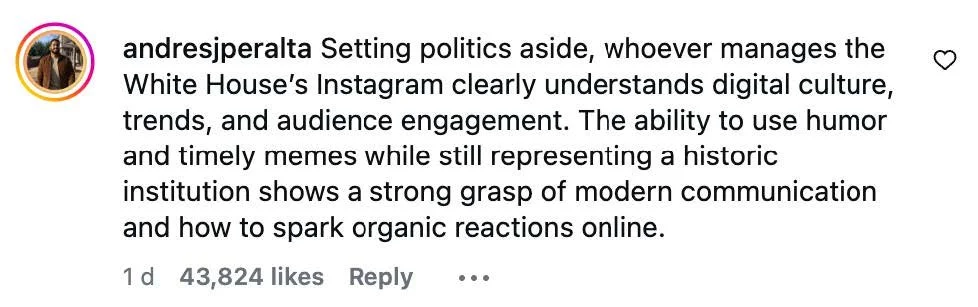
With that said, the blurring of political messaging and entertainment is worrying and has been happening for some time now. It feels that underpinning the White House’s meme communications ‘strategy’ is a kind of nihilism that government is just another form of entertainment with no moral mission or real accountability.
Closer to home, London’s Metropolitan Police have also used meme humour in their videos to show how they go about their business. A recent video posted on the Met’s TikTok and Instagram used the unmistakable sounds and aesthetics of Mario Kart to illustrate a police chase in the early hours of a summer morning. The use of a video game in this case, lightens the tone of the situation treating a matter of law and justice as if it were an actual video game. It’s trivial and doesn’t attempt to contextualise the situation in an appropriate or holistic way.
With an estimated 1 billion daily users and an average of 120 videos viewed per day on TikTok, many audiences are now conditioned to the visual sugar rush and speed typical on the platform.
Even the UK Home Office has adopted a similar style of visual communications recently, albeit with a more serious tone. Their new TikTok account @SecureBordersUK shows a range of short videos comprised of fast edits with a clear ‘law and order’ message. It’s clear these videos are tailored to communicate urgency and government action being taken to ‘crack down’ on illegal migration.
However, there’s little nuance or detail in these videos giving a well-rounded image of the scenario. Montages of the police breaking into homes and carrying people off in handcuffs only work to dehumanise and objectify the individuals being apprehended. The short videos simply ascribe guilt and subsequently justify a heavy-handed response to ‘clean up’ Britain’s streets, leaving the viewer without any human detail.
Memes are designed for speed, humour, and emotional deflection. When used by powerful institutions, memes dull public sensitivity to real harm as they oversimplify and trivialise matters. Such videos risk reducing human suffering to shareable moments whilst enabling the institution to evade accountability and critical interrogation of what’s actually going on.
So, what can be done?
To a large extent, you could view these institutions as simply adapting to the new communications environment and striving for the dominant metrics of social media: gain attention, go viral and get engagement.
When public institutions communicate like brands, citizens are treated as passive consumers rather than active participants in democracy. Public institutions should be focused on serving the population, not pursuing their own aggrandisement.
As visual communicators we have influence and power on how ideas and messages are promoted. So, instead of pandering to the speed of the platform, leaders and facilitators should create spaces for dialogue that aren’t hostage to the 7-second attention span.
Here are some ideas on how we could move forward:
Tell better stories – ones of hope that capture the depth and breadth of the humanity of their subjects. Memes evolved to help users cope with fear, chaos, absurdity, and overload. Whilst they have their place, we can counter the ‘whatever bleeds, leads’ mentality by filling the well of stories with hope and possibility.
Explore slower, more holistic forms of storytelling that dignify the subject in question and inform audiences of the fuller story. We at TC & Friends enjoy exploring topics through panel talks and fireside chats that provide a forum for discussions and depth. A race to the bottom isn’t inevitable – we can create better systems that uplift and dignify.
An ethical framework for the digital age – with great power comes great responsibility…remember the Nolan Principles of Public Life? Published in 1995 in the UK, they were developed as a guide for public office holders, ensuring decisions serve the public interest, not personal gain, and promoting trust and high standards in government and public services. The principles are Selflessness, Integrity, Objectivity, Accountability, Openness, Honesty, and Leadership. We could call it MEGA – Make Ethics Great Again…
